Selling Your California Home After a Divorce

Short answer: in most California divorces, you don't have to sell the house right away. You have real options, including a buyout or a delayed sale. But timing does matter, especially for taxes and property tax reassessment, and the earlier you understand your options, the more control you'll have over the outcome.
This isn't legal or tax advice. Divorce and real estate touch each other in ways that are specific to your situation, your title, your loan, and your decree. What follows is the general framework I walk San Fernando Valley homeowners through, so you can ask your attorney and tax professional better questions and make decisions from a place of clarity instead of guesswork.
Do You Have to Sell the House When You Divorce in California?
California is a community property state. In simple terms, that means a home bought during the marriage usually belongs to both spouses equally, no matter whose name is on the loan or who has been making the payments. There are exceptions. If one of you owned the home before the marriage, or inherited it, or a prenuptial agreement addresses it, the house may be treated differently. An attorney can confirm how your home is classified, because that changes everything else about your options.
Assuming it is community property, there are usually three paths. You sell the home and split the proceeds. One of you buys out the other's share and keeps the house. Or you agree to keep it jointly for a period of time, often while kids finish school, and sell later.
Selling isn't required by law. It's a decision the two of you make, based on what's realistic. Can one spouse actually afford the mortgage, taxes, and upkeep alone, and qualify to refinance the loan into one name? Is there enough equity for a fair buyout? Does either of you actually want to stay tied to a shared property once the marriage is over? If you can't agree, a judge can order a sale as part of the divorce judgment. That's a conversation for your family law attorney, not your Realtor.
Should You Sell Before or After the Divorce Is Final?
This is the question that gets skipped the most, and it can cost real money. The IRS lets homeowners exclude a portion of the profit from a home sale from capital gains tax, as long as you meet an ownership and use test (generally, you owned and lived in the home for at least two of the last five years). A single filer can exclude up to $250,000 of gain. A married couple filing a joint return can exclude up to $500,000.
Here's the part that matters for timing: if you sell while you're still legally married and file a joint return, and you both meet the use test, you may be able to use the full $500,000 exclusion together. Once the divorce is final, you're each limited to $250,000 as individual filers. On a San Fernando Valley home that's appreciated significantly over ten, twenty, or thirty years, that difference can be meaningful.
There's also a helpful IRS provision for couples who are separated but not yet divorced. If one spouse moves out, but a separation or divorce agreement allows the other spouse to keep living in the home, the spouse who moved out can still count that time toward the "use" requirement. Moving out doesn't automatically disqualify you.
And if the home is transferred from one spouse to the other as part of the settlement, rather than sold on the open market, that transfer itself generally isn't treated as a taxable sale. The spouse who receives the home also takes on the original ownership period and cost basis, which matters when they eventually sell.
None of this is a reason to rush a decision you're not ready for. It's a reason to talk to a CPA or tax professional early, alongside your attorney, before you and your spouse settle on a timeline. Source: IRS Publication 523, Selling Your Home.
What Happens to Your Property Taxes If One Spouse Keeps the House?
A lot of people worry that if the house is transferred into one spouse's name, the county will reassess it at today's market value and property taxes will jump. In California, that fear is usually unfounded. Transfers of real property between spouses, including transfers made as part of a divorce settlement or court order, are automatically excluded from reassessment. No claim form is required for that transfer, and the home keeps its existing assessed value under Proposition 13.
That protection covers the transfer between the two of you. It doesn't extend to a future sale. If the spouse who keeps the house later sells it to someone outside the marriage, that sale is a normal change of ownership, and the new buyer's taxes will be based on the current market value, the same as any other home sale.
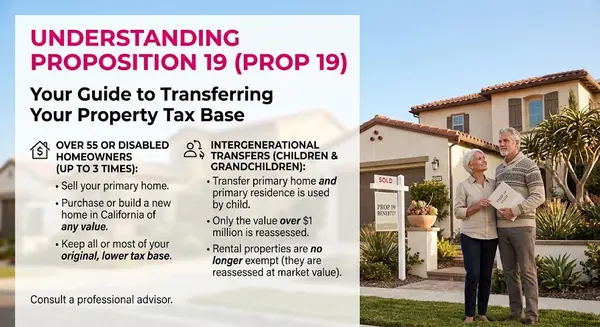
If either of you is 55 or older and plans to buy a replacement home in California later, Proposition 19 may also let you carry your current low tax base to that new home. It's worth asking your tax professional or the county assessor's office whether that applies to your situation. Source: California State Board of Equalization, Change in Ownership FAQ.
How to Sell the House Together When You're Not on the Best Terms
Most divorcing couples aren't communicating easily, and that's exactly when a home sale can go sideways. A few things make it smoother. Choose one agent that both of you agree on and trust, rather than each of you bringing in your own. A neutral agent becomes the single point of communication and keeps pricing and marketing decisions out of the middle of your disagreements.
Put the important decisions in writing, ideally reviewed by your attorneys: how the list price will be set, who pays for repairs or updates before listing, and exactly how the proceeds get divided and when. Verbal agreements tend to fall apart under stress. A short written understanding prevents a lot of disputes later.
If living in the house together during the sale isn't workable, talk through a showing schedule or whether one of you will stay elsewhere temporarily. And if a buyout is on the table instead of an open-market sale, get a written appraisal from a licensed, neutral appraiser. That number should come from a professional, not from either of your guesses about what the home is worth.
Because I spent years underwriting mortgages before I became a Realtor, I can also walk you through what a lender will actually require if one of you plans to refinance and buy out the other. That way you're not agreeing to a number that falls apart once the loan application starts.
Mistakes That Cost Divorcing Sellers Money and Time
The most common one is waiting too long to talk to a tax professional about timing, then finding out the exclusion rules would have changed the decision. Another is letting emotion set the price, either too high out of principle or too low just to be finished with it. Neither serves you well.
Skipping loan verification is another costly mistake. Before agreeing to a buyout, confirm the mortgage payoff amount and whether the loan can actually be assumed or needs to be refinanced. And without a written agreement on how proceeds, remaining mortgage, and closing costs will be split, disagreements tend to surface right when you're closest to closing, which is the worst time for them to appear.
Frequently Asked Questions
Do both spouses have to agree to sell the house in a California divorce?
Generally, yes, if the home is community property. If you can't reach an agreement, either spouse can ask the family court to decide, and a judge can order a sale as part of the divorce judgment. This is a legal question your family law attorney should confirm for your specific case.
Can I sell my house before my divorce is final in California?
In many cases, yes, especially if you both agree to sell. Selling while still legally married and filing a joint return can also affect how much of the gain qualifies for the capital gains exclusion, which is worth reviewing with a tax professional before you decide on timing.
Will I owe capital gains tax when I sell my house during a divorce?
It depends on your gain, your filing status, and whether you meet the IRS ownership and use tests. Many sellers owe little or nothing because of the $250,000 (single) or $500,000 (married filing jointly) exclusion, but this varies by situation. A CPA can run the numbers for you before you list.
Does transferring the house to my spouse as part of the divorce raise our property taxes?
No. Transfers between spouses, including those made as part of a divorce settlement, are excluded from property tax reassessment in California. The home keeps its existing assessed value. A future sale to someone outside the marriage is a separate event and will be reassessed normally.
What if my spouse won't cooperate with selling the house?
This is a legal matter, not a real estate one, and it's best handled by your family law attorney. Courts have tools to resolve a standoff, including ordering a sale. Once there's a clear path forward, whether through agreement or court order, I can help with the real estate side.
A Low-Pressure Next Step
Selling a house during a divorce is never just a real estate transaction. It's one more decision in a season that already has too many. My job isn't to rush you toward a sale. It's to give you clear, honest information so you and your attorney can make the choice that actually works for your family, on your timeline. If you'd like to talk through your specific situation quietly, without any obligation to list before you're ready, I'm here.
Categories
Recent Posts








Send me a message!

Agent License ID: 01840894