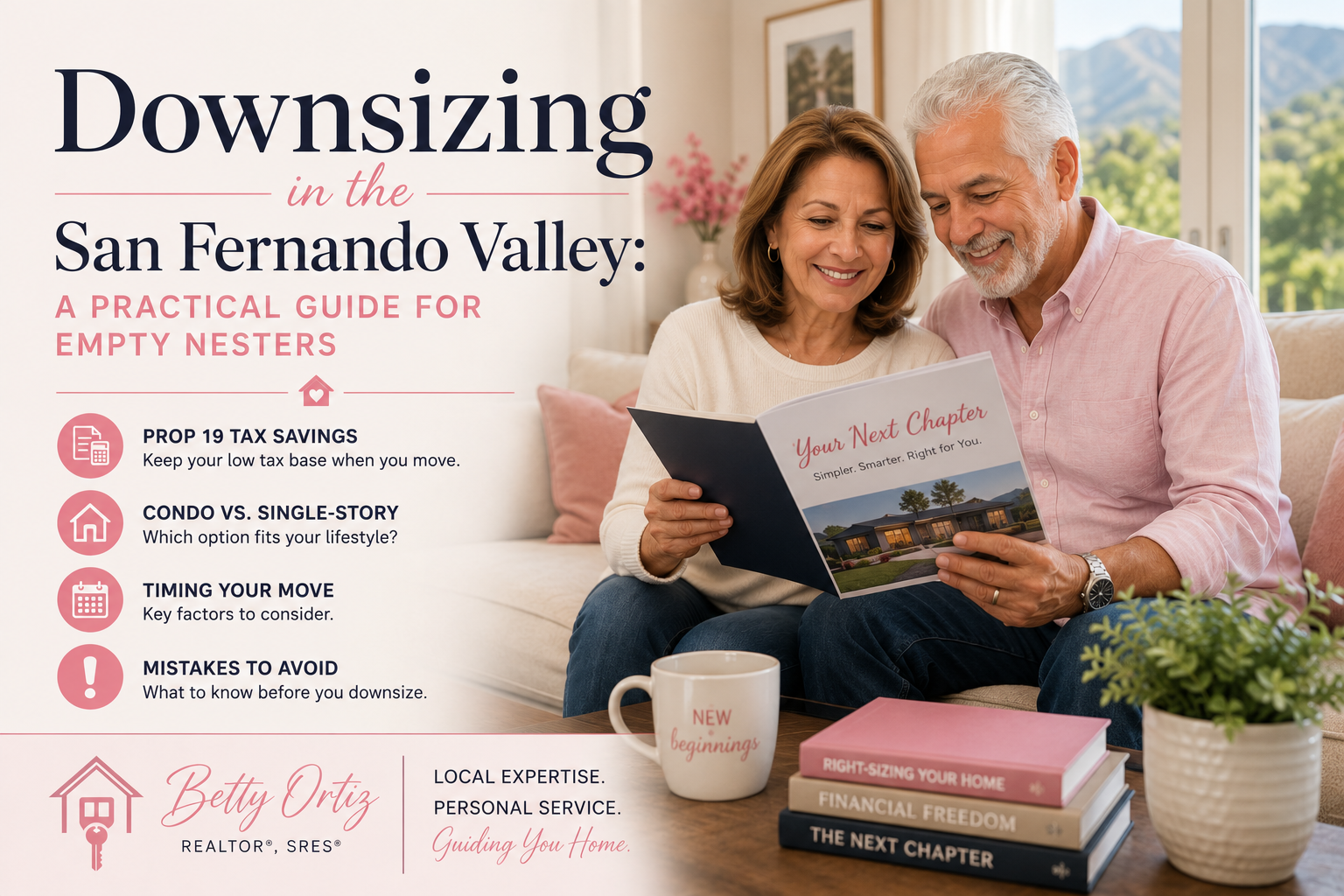
Downsizing in the San Fernando Valley: A Practical Guide for Empty Nesters
Quick Answer
If you're an empty nester in the San Fernando Valley wondering whether now is the right time to downsize, here's the short version: it's usually less about your age and more about whether your home still fits your life. With San Fernando Valley single-family home prices hitting a record median of $1,188,000 in June 2026, up 3.3% from a year earlier, most longtime owners have built significant equity, and that equity is the real engine behind a smart downsize.
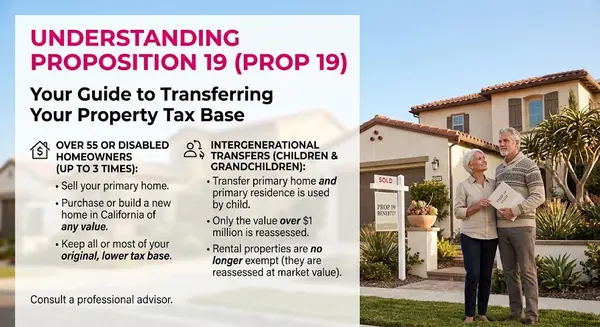
The biggest financial lever most people miss is Proposition 19. If you're 55 or older, you can transfer your current property tax base to a new home anywhere in California, up to three times in your lifetime. That means you could move into a smaller, easier-to-maintain home without your property taxes jumping to today's assessed value. This alone changes the math for a lot of Valley homeowners who assumed downsizing would cost them their low tax bill.
Your main paths are a single-story home, a condo or townhome, an accessory dwelling unit (ADU) on land you already own, or a move to independent or assisted living if you need more support. There isn't a universal "best" choice. It depends on how much maintenance you want to keep doing, whether you want to stay near family in the Valley, and how much of your equity you want to put into your next home versus keep in the bank.
Below, I'll walk through every option in detail, including the tradeoffs nobody tells you about, the tax rules that actually apply here in California, and the mistakes I see longtime SFV homeowners make when they downsize too fast or too slow.
If you're looking for...
Why This Decision Matters More Than People Realize
I've sat at a lot of kitchen tables in Northridge, Granada Hills, and Chatsworth with people who raised their families in the same four-bedroom home for 25 or 30 years. The conversation almost always starts the same way: "We only use two rooms now." What follows is usually a mix of relief and guilt, relief at the idea of less to clean and less to worry about, and guilt about leaving a home full of memories.
Here's what I tell them. Downsizing done well isn't about giving something up. It's about converting a home that no longer fits your life into money, time, and freedom that does. Done poorly, it's rushed, expensive, and stressful. The difference almost always comes down to planning early and understanding the financial rules that are specific to California and to homeowners over 55.
This guide exists because most downsizing articles are written for a national audience and skip the details that actually matter here: Prop 19's tax base transfer, how thin the true 55+ community inventory is inside the Valley, and how much the SFV's current record-high prices change the equity conversation for people who bought decades ago.
| Option | Best For | Pros | Cons | Maintenance | Stays in SFV? |
|---|---|---|---|---|---|
| Single-story home, smaller footprint | Owners who want privacy and no shared walls | No stairs, full control of the property, easiest to age in place | You still handle all upkeep and repairs yourself | Full responsibility | Usually yes |
| Condo or townhome | Owners ready to hand off exterior maintenance | HOA covers roof, grounds, often exterior; more security | HOA dues, rules, and shared decision-making | Low | Yes, many Valley options |
| ADU on your current lot | Owners who love their location and want to stay put | Keeps your land and Prop 19 base intact; can generate rental income | Upfront construction cost and permitting timeline | Full responsibility | Yes, same property |
| Independent or assisted living | Owners who want built-in support and community | Meals, activities, and care options available on-site | Monthly cost, less autonomy than a private home | None | Limited SFV options, more near Northridge/Granada Hills |
| Sell and relocate out of the Valley | Owners prioritizing maximum equity and lower cost of living | Can carry Prop 19 tax base statewide; often frees up the most cash | Leaving established community, doctors, and routines | Varies | No |
Exact pricing varies by neighborhood, condition, and current inventory. These are general tradeoffs, not price quotes. Ask me for current comps in your target area before you make a decision.
Connect with Betty Get a Home Valuation
How I'd Rank These Options, Honestly
Rankings only mean something if they're honest about who each option is actually for. Here's how I'd order these five paths for a typical SFV empty nester who wants to keep more money, less maintenance, and a good quality of life. Your situation may flip this order, and that's the point of the sections below.
- Condo or townhome in the Valley. For most people I work with, this earns the top spot because it solves the two biggest complaints I hear (yard work and repairs) while keeping you close to family, doctors, and the community you already know.
- Smaller single-story home. A close second. You keep full control and privacy, but you're still the one calling the roofer and mowing the lawn, even if the lawn is smaller.
- ADU on your current property. Ranked third because it's the most underused option with real upside, especially for owners who aren't ready to leave their neighborhood at all. The tradeoff is cost and time.
- Relocating out of the Valley. This ranks fourth not because it's a bad choice, but because it's the one with the most to lose emotionally if it's rushed. Financially it can be the strongest move; personally it's the hardest to reverse.
- Independent or assisted living. Ranked last only because it fits a narrower group, those who specifically want or need daily support. When that's the need, it's often the right call, and waiting too long to make it is the more common mistake.
A Closer Look at Each Option
Condo or Townhome in the San Fernando Valley
It directly answers the two complaints I hear most from longtime homeowners: too much yard, too much upkeep. Encino, Sherman Oaks, Woodland Hills, and Studio City all have meaningful condo and townhome inventory.
The strongest all-around choice for owners who want to stay in the Valley and simplify. It's not for everyone, but for most it's the best balance of lifestyle and location.
Owners who travel, want lock-and-leave simplicity, or are tired of exterior maintenance.
You dislike HOA rules, shared walls, or monthly dues on top of your mortgage.
Unlike a smaller single-family home, most of the maintenance burden shifts off your shoulders and onto the HOA.
Encino's condo inventory tends to run considerably below the area's single-family median, which is why I see so many Encino sellers downsizing without leaving the neighborhood they raised their kids in.
Always ask for the HOA's reserve study before you write an offer. A healthy reserve fund tells you whether a special assessment is coming.
Late spring through early fall tends to bring the most inventory, but serious sellers list in every season here.
Look for single-level units or buildings with elevators if stairs are a long-term concern. Not all Valley condo buildings have them.
Proximity to Ventura Boulevard, medical offices, and grocery access matters more once you're not driving as far for work.
HOA dues can rise significantly after a special assessment. Ask for two years of HOA meeting minutes, not just the current budget.
Buying a condo without visiting at different times of day, so noise, parking, and traffic patterns come as a surprise later.
for owners prioritizing low maintenance and community proximity.
A Smaller, Single-Story Home
No stairs, full privacy, and no HOA. It's the option that feels most like "just a smaller version" of what you already know.
Excellent if you want to keep full control of your property and aren't bothered by handling your own maintenance.
Owners who want privacy, a yard, or space for pets and visiting grandchildren.
You're specifically trying to eliminate maintenance responsibilities, not just square footage.
You're trading size, not responsibility. That's an important distinction many sellers overlook.
Northridge and Granada Hills tend to offer more single-story tract-home stock at a relative value compared to Encino or Sherman Oaks.
Widen your search to homes with 2 to 3 bedrooms instead of insisting on exactly what you need today. A guest room for grandkids matters more than people expect.
Spring listings tend to move fastest, but well-priced homes sell in any season in this market.
Single-story living is one of the best long-term choices for aging in place comfortably.
Distance to your current doctors, pharmacy, and family matters more than it did when you bought your first home.
Older single-story homes sometimes have narrower doorways or step-up entries that matter later for mobility. Walk the home with that lens.
Downsizing the square footage but not the yard, so you end up with the same amount of outdoor upkeep in a smaller house.
, especially for owners who prioritize privacy over convenience.
Building an ADU and Staying Put
It's the option almost nobody brings up first, and it deserves more attention. You downsize your daily footprint without leaving your land, your neighbors, or your Prop 19 tax base.
A smart middle path for owners who love their location more than they dislike their current home's size.
Owners who want to age in place on familiar ground, or who want rental income potential.
You want to be fully done with construction, permits, and contractor decisions.
Unlike every other option here, you're not selling. You're right-sizing your living space while keeping the asset.
Many Valley lots, especially in Northridge, Reseda, and Van Nuys, have enough space for a detached ADU, but zoning and lot size still need to be verified property by property.
Start with the City of Los Angeles Department of Building and Safety's ADU guidelines before you talk to a contractor, so you know your baseline options.
Begin the permitting process well before you need the space. Timelines vary and are outside anyone's direct control.
You can design a single-level ADU specifically for long-term mobility needs, which is a real advantage over buying an existing home.
Not applicable. You already know the neighborhood.
An ADU can affect your homeowner's insurance and your property tax reassessment on the new structure specifically. Confirm both before you build.
Underestimating the total cost and timeline, or building a space that doesn't actually solve the accessibility needs you'll have in 10 years.
if you plan to stay in the Valley indefinitely.
Selling and Relocating Out of the Area
For owners chasing maximum financial freedom, especially those with decades of equity built into a home now worth well above what they paid, this can unlock the most cash and the lowest ongoing cost of living.
Financially, often the strongest option. Personally, the one that needs the most honest conversation before you commit.
Owners without strong ties keeping them in the Valley, or those moving to be near out-of-area family.
Your community, doctors, and support system here are central to your quality of life.
You can still carry your Prop 19 tax base to a replacement home anywhere in California, so relocating within the state doesn't reset your property taxes.
I've seen more Valley homeowners exploring this path recently as home values have climbed, since selling now can fund a very different retirement than it could a decade ago.
Visit your target area in more than one season before committing. A place that looks perfect in October can feel very different in July.
Plan around your target area's market cycle, not just the Valley's.
Research healthcare access in your new area as carefully as you research the home itself.
Distance from your Valley-based family and friends is the real variable to weigh here, not amenities.
If you sell before buying, you have a two-year window under Prop 19 to purchase your replacement home and still transfer your base year value.
Underestimating how much they'll miss their community, or moving before testing the new area with an extended visit.
, lowest emotional certainty.
Independent or Assisted Living Community
When daily support, meals, or medical proximity become a real need rather than a preference, this is the option that actually solves the problem.
The right choice for the right person at the right time, and one people often wait too long to consider.
Owners who want built-in community and support, or family members concerned about a loved one living alone.
You're still fully independent and mainly looking to simplify, not to add support services.
It's a service and lifestyle decision as much as a real estate one, which is why it deserves its own conversation, often with adult children involved.
Several independent and assisted living communities cluster around Northridge and Granada Hills, near the 405 and 118 freeways, which keeps them accessible to family across the Valley.
Tour at mealtime and during an activity, not just during a scheduled sales tour. It tells you far more about daily life there.
Whenever the need is real. Waiting for a "better time" is the most common regret I hear from families.
Built in, by design, which is the core value proposition of this option.
Proximity to family for regular visits matters more here than proximity to shopping or restaurants.
Monthly costs often increase with care level over time. Ask for the full fee schedule, not just the entry-level rate.
Waiting for a health crisis to force the decision instead of planning while there's still time to choose well.
specifically for those who need daily support, not a fit for everyone else.
What Most Downsizing Articles Get Wrong About the Valley
A few things I wish more homeowners knew before they start this process:
- True 55+ communities are rare inside the Valley itself. If you picture a gated, amenity-rich 55+ development like you'd find in Simi Valley or Newbury Park, that inventory is thin inside the San Fernando Valley proper. Most of the Valley's housing stock is standard single-family and condo product, not age-restricted. Don't assume that option exists here without checking first.
- Prop 19 lets you buy up, not just down. Most people assume the tax base transfer only works if you buy a cheaper home. It also works if your replacement home costs more, with a value adjustment based on how soon you buy relative to your sale. That opens the door to a nicer smaller home instead of just a cheaper one.
- ADUs are underused as a downsizing tool. Everyone thinks of ADUs as a way to add rental income. Fewer people consider them as a way to downsize without moving at all.
- Longtime owners are sitting on more equity than they realize. With the Valley's single-family median hitting $1,188,000 in June 2026, homeowners who bought decades ago often have far more flexibility than they assume, especially once Prop 19 is factored in.
Best By Situation
Best Overall
Condo or townhome in the Valley, for the best balance of simplicity and staying close to home.
Best Value
A smaller single-story home in Northridge or Granada Hills, where relative pricing tends to stretch further.
Best for Staying Put
An ADU on your existing property, if your lot and zoning allow it.
Best for Maximizing Equity
Selling and relocating out of the Valley while carrying your Prop 19 tax base.
Best for Family Proximity
Staying within the same city or an adjacent one, even if it means a smaller upgrade in maintenance savings.
Best for Built-In Support
Independent or assisted living near Northridge or Granada Hills.
Best Kept Secret
The ADU route. Most owners never seriously consider it, and it deserves more attention than it gets.
Best for Low Stress Transition
Starting the decluttering and planning process at least four to six months before you list.
Connect with Betty Get a Home Valuation
Timing Your Downsize
Spring
Traditionally the most active season for Valley inventory. More competition, but also more homes to choose from if you're buying your next place.
Summer
Family moves are common, which can mean more single-family competition. Still a strong season for serious, motivated sellers.
Fall
Often quieter, which can favor buyers negotiating on price and sellers who priced correctly from the start.
Winter
Fewer listings, but the buyers and sellers who are active tend to be serious. Not a bad time to move if your situation calls for it.
Weekday showings tend to draw more serious buyers, while weekend open houses bring the highest traffic. If you're the one buying, I generally recommend touring homes on both a weekday and a weekend before you make a decision, since traffic, parking, and noise can look very different depending on the day.
If You're Moving Into the Valley to Downsize
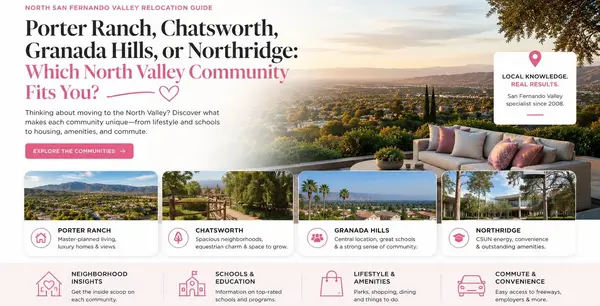
Not everyone downsizing into the San Fernando Valley already lives here. If you're relocating from outside the area, a few things are worth knowing. Commute patterns matter even in retirement, since traffic on the 101, 405, and 118 still shapes how long it takes to reach family, medical appointments, or the airport. Encino and Sherman Oaks tend to offer the most walkable, amenity-dense options along Ventura Boulevard. Northridge, Granada Hills, and Chatsworth generally offer more relative value and quieter, more suburban streets. Porter Ranch and West Hills tend to skew newer in housing stock, which can mean fewer maintenance surprises in a smaller home.
Whichever city you choose, spend time there outside of a single house-hunting trip if you can. The Valley's climate, traffic patterns, and neighborhood character can feel different in person than they do from a listing photo.
Not sure which path fits your situation?
Every homeowner's numbers, timeline, and priorities are different. If you'd like a straightforward, no-pressure conversation about what downsizing could look like for you, including a current equity estimate and how Prop 19 might apply to your specific home, I'm happy to help.
Talk with Betty Get a Home ValuationFrequently Asked Questions
What is the best age to start thinking about downsizing in the San Fernando Valley?
There is no single right age. Most of the homeowners I work with start seriously thinking about it somewhere between their late 50s and mid-70s, usually triggered by an empty bedroom, a set of stairs that got harder to manage, or a desire to free up equity. The better question isn't your age. It's whether your current home still fits your daily life.
Will I lose my low property tax base if I downsize in California?
Not necessarily. Under Proposition 19, homeowners 55 or older can transfer their existing property tax base to a new home anywhere in California, up to three times in their lifetime. Talk with your Realtor and the county assessor's office about the specific timing rules before you sell.
How does Prop 19 actually help empty nesters who want to downsize?
It lets you sell a home you've owned for decades, one that may be assessed at a fraction of its market value, and carry that same low tax base to your next home, even if the new home costs more. There are timing rules, generally buying within two years of the sale, and value adjustments if the replacement home costs more than the one you sold.
Is it better to buy a condo or a single-story house when downsizing in the Valley?
It depends on what you're trying to solve. A single-story home usually gives you more privacy and no shared walls, but you're still responsible for the roof, the yard, and every repair. A condo or townhome typically means less maintenance and often more security, but you take on an HOA and shared decision-making. Neither is universally better.
Do I have to pay capital gains tax when I sell my longtime family home?
Under IRC Section 121, single filers can exclude up to $250,000 of gain and married couples filing jointly can exclude up to $500,000, as long as you owned and lived in the home as your primary residence for at least two of the last five years. Given how much equity many longtime SFV owners have built, some sellers do exceed that exclusion. California taxes any gain above the exclusion as ordinary income. This isn't tax advice, so please talk with a CPA about your specific numbers.
Are there real 55+ communities in the San Fernando Valley?
Fewer than most people expect. Unlike Simi Valley or Newbury Park, which have dedicated age-restricted communities, the Valley itself is mostly standard single-family and condo housing stock. Some SFV cities do have independent and assisted living communities, especially around Northridge and Granada Hills, but a true age-restricted, amenity-rich 55+ community usually means looking just outside the Valley.
Should I sell my current home before or after I find my next one?
In most cases, I recommend getting pre-positioned and having a clear target before you list, then timing your sale and purchase close together, sometimes with a rent-back or bridge arrangement. The right sequence depends on your comfort with risk and the current market, which is exactly why this needs a real conversation.
What do I do with decades of belongings when downsizing?
Start earlier than you think you need to, ideally three to six months before you plan to list. Sort in small sessions by room, not all at once. A senior move manager can be worth the cost if the process feels overwhelming.
Is building an ADU on my property a good downsizing option?
For some homeowners, yes. It lets you downsize your daily footprint while staying on land you already own, in the neighborhood you already know. The tradeoff is the upfront cost and permitting timeline.
How long does the downsizing process usually take from start to finish?
For most of my clients, plan on somewhere between four and nine months from the first serious conversation to the keys changing hands on both ends. Rushing the sorting and decision-making stage is where I see people regret the process afterward.
Related Reading on This Site
- Is It a Good Time to Sell My Home in the San Fernando Valley in 2026?
- Chatsworth Real Estate Market Update: What Homeowners Need to Know in 2026
- More People Are Leaving California Than Any Other State. Where Are They Moving?
- Get a free home valuation
- Sell my home in the San Fernando Valley
External Sources Referenced
Tax and legal rules change and can vary by individual circumstance. This guide is general information, not tax, legal, or financial advice. Please verify current details with the assessor's office, the IRS, or your CPA before making a decision, and confirm current market data before relying on any figures above.
Final Thoughts
Downsizing in the San Fernando Valley isn't just about square footage. It's about matching your home to the life you actually want to live right now, with the equity, freedom, and support that fits you best. Whether that means a condo in Sherman Oaks, a single-story home in Northridge, an ADU on the lot you already own, or a completely new city, the right answer comes from your specific numbers and priorities, not a generic rule.
If you've read this far, you're already ahead of most homeowners who put this decision off for years. The next step is simple: get a clear picture of your home's current equity and how Prop 19 applies to your specific situation, then decide from there with real numbers in front of you, not guesses.
Categories
Recent Posts







Send me a message!

Agent License ID: 01840894