Prop 19 California: What San Fernando Valley Homeowners Need to Know
Don't Let a Bigger Tax Bill Stop You From Moving
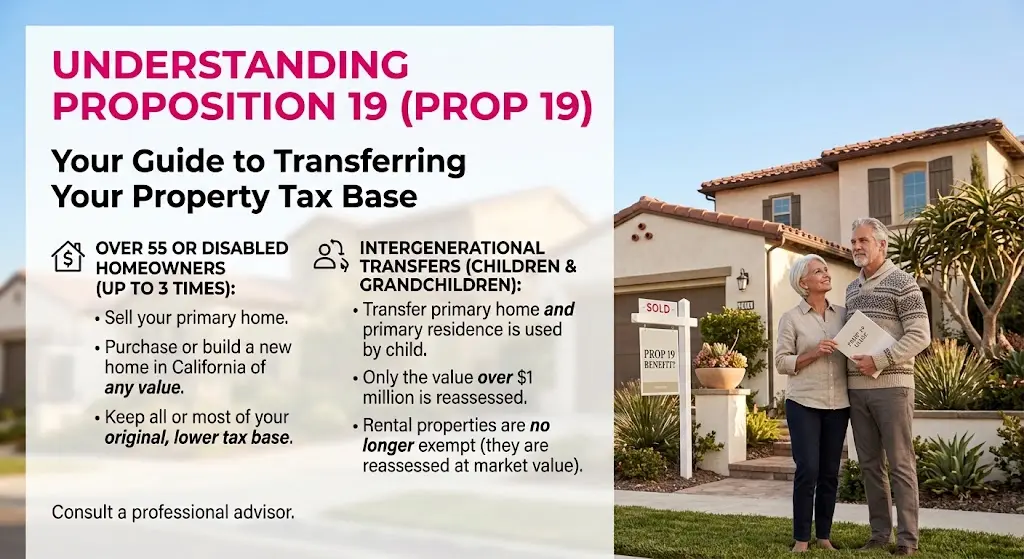
Quick answer: Prop 19 lets homeowners 55 and older, people with severe disabilities, and wildfire or disaster victims carry their current property tax bill to a new home anywhere in California, up to three times. It also changed how parents can pass a home to their kids without a full tax reassessment. The rules are generous, but they come with strict timelines and conditions that trip people up.
If you've owned your San Fernando Valley home for a long time, Prop 19 probably affects you more than you think, whether you're planning to downsize, move closer to family, or leave the house to your children someday.
I talk to homeowners about this almost every week. Someone will tell me they'd love to sell their four-bedroom house in Northridge and move into something smaller in Porter Ranch, but they're scared that a new property tax bill will wipe out the savings. Or they're wondering what happens to their tax base when they eventually leave the house to their kids.
Both of those situations are covered by Prop 19. Here's what it actually says, in plain language, and what it means for you if you live in the Valley.
What Prop 19 Actually Changed
California voters passed Proposition 19 in November 2020, and it took effect in two parts: the parent-child transfer rules started February 16, 2021, and the base year value transfer rules for people 55 and older started April 1, 2021.
Before Prop 19, your property tax bill was tied to your home's purchase price under Prop 13, and it could only go up 2% a year no matter how much your home's market value increased. That part hasn't changed. The problem was always what happened when you wanted to move. If you sold your home and bought a new one, the new home usually got reassessed at full market value, and your tax bill could jump dramatically, even if you were downsizing.
Prop 19 fixed that for a specific group of people, and it tightened the rules for another group. It's really two different provisions living under one name, so let's look at each one.
The 55-and-Older Rule: Take Your Tax Bill With You
If you're 55 or older, severely and permanently disabled, or you lost your home in a wildfire or a Governor-declared disaster, you can sell your home and transfer your current taxable value to a new primary residence anywhere in California. This is a big change. Before Prop 19, that kind of transfer was only allowed within the same county or between a small list of counties that agreed to accept it. Now it works statewide, and you can use it up to three times in your life (disaster victims have no limit).
You have two years from the sale of your old home to buy or finish building the new one, and both properties have to be your primary residence, not a rental or vacation home.
What if the new home costs more?
Your old taxable value transfers over cleanly if your replacement home costs the same or less than your old home's market value. If it costs more, the difference gets added to your transferred base year value, and how much room you have depends on timing:
If you buy the new home before you sell the old one, you get the full market value of your old home as your cushion. If you buy within a year after selling, that cushion grows to 105% of your old home's value. If you buy in the second year after selling, it's 110%. Anything above that gets added to your new assessed value.
Say your Northridge home has a current assessed value of $310,000, but it's worth $900,000 on the market. If you sell it and buy a $780,000 home in Porter Ranch within the same year, your new assessed value would still be $310,000, since $780,000 is under the 105% cushion. Your tax bill barely moves.
You file this with a form called BOE-19-B, through the county assessor where your new home is located. You have three years from the purchase to file and still get the tax break applied retroactively to the purchase date. File later than that, and you'll only get relief going forward from the filing date, not backdated.
Wondering what this means for your home specifically?
Every situation is different depending on your current assessed value, timing, and where you're moving. I can help you run the real numbers.
Talk to Betty About My MoveLeaving the House to Your Kids: What Changed With the Parent-Child Exclusion
This is the part that catches people off guard, because it used to be much simpler. Before Prop 19, parents could pass a home, or even a rental property, to their kids without any reassessment at all, up to $1 million of assessed value.
Prop 19 narrowed that. Now the exclusion only applies if the child moves into the home as their primary residence within one year of the transfer, and they have to file for the homeowners' exemption to prove it. If they keep the house as a rental or a second home, the property gets reassessed at current market value.
There's also a value cap now. The exclusion covers the home's assessed value plus $1,044,586 (that figure adjusts every two years; the next adjustment is February 2027). If the home's market value at the time of transfer is higher than that combined number, the excess gets added to the new taxable value. So it's not a full reassessment like it would be for an unrelated buyer, but it's not always a clean pass-through either.
The same rules apply to grandparent-to-grandchild transfers, but only if the grandchild's parents have both passed away.
Family farms get a break here too. They qualify for the exclusion without the primary residence requirement.
One detail people often miss: once your child moves in and claims the exclusion, they're expected to keep living there. If they move out and rent the place a few years later, the assessor can reassess it at that point. This isn't a one-time paperwork exercise. It's an ongoing condition.
What This Means If You're Planning Ahead in the San Fernando Valley
Most of the homeowners I work with in Chatsworth, Granada Hills, West Hills, and Tarzana have owned their homes for fifteen, twenty, thirty years or more. Their assessed values are often a small fraction of what their homes are worth today, thanks to Prop 13's 2% annual cap. That's exactly the situation Prop 19 was written for.
If you've been holding off on downsizing because you assumed a new tax bill would erase the benefit of selling, it's worth running the actual numbers before you rule it out. I've sat down with clients who thought a move would cost them thousands more a year in property tax, and once we walked through the base year transfer, the math looked completely different.
On the inheritance side, I've also seen families get surprised after the fact, usually because nobody told them about the one-year move-in deadline or the homeowners' exemption filing. If passing your home to your kids is part of your long-term plan, it's worth having that conversation with your family and a qualified estate attorney or CPA now, not after you've already made a decision.
Common Mistakes to Avoid
The biggest one is missing the one-year move-in window for parent-child transfers. Life gets in the way, a child is finishing a lease or waiting on a job transfer, and by the time they move in, they've lost the exclusion.
The second is assuming the base year transfer is automatic. It isn't. You have to file the claim with the county assessor, and if you miss the three-year window, you lose the retroactive part of the benefit.
The third is treating this as a simple form to fill out instead of a financial decision with real numbers behind it. Prop 19 is generous, but the value caps, timing windows, and occupancy requirements are specific enough that a mistake can cost real money. I'm not a tax advisor or an attorney, and I always recommend confirming your exact numbers with your county assessor's office and a CPA or estate planning attorney before you make a final decision.
Frequently Asked Questions
Does Prop 19 apply if I move outside Los Angeles County?
Yes. Prop 19 made the base year value transfer statewide. You can sell your home in the San Fernando Valley and buy your replacement home in any California county, as long as it becomes your primary residence within two years.
What happens if my new home costs a lot more than my old one?
You'll pay tax on the amount above your allowed cushion. That cushion is 100% of your old home's market value if you buy before you sell, 105% if you buy within a year after selling, and 110% if you buy in the second year after selling.
Can my kids keep the house as a rental and still get the parent-child exclusion?
No. They have to move in and make it their primary residence within one year, and file for the homeowners' exemption. If they use it as a rental or vacation home instead, the property gets reassessed.
How long do I have to file the paperwork?
Three years from the purchase date (for the 55-and-older transfer) or three years from the transfer date (for the parent-child exclusion) to get the full retroactive benefit. You can file later, but you'll only get the tax relief going forward from that point.
Can I use the 55-and-older transfer more than once?
Yes, up to three times in your lifetime. Wildfire and disaster victims don't have a limit on how many times they can use it.
Should I talk to anyone besides a Realtor about this?
Yes. I can walk you through what a move would likely mean for your specific home and help you get the timing right, but the final tax numbers should be confirmed with your county assessor's office, and any estate planning decisions should go through a CPA or estate attorney.
This article is for general education and reflects Prop 19 rules as of August 2026. Property tax rules and adjustment amounts can change. Please confirm current figures and your eligibility with the county assessor's office or a qualified tax professional before making a decision.
Categories
Recent Posts









Send me a message!

Agent License ID: 01840894